
Readers’ Rando Bikes
A selection of VeloWeb readers’ randonneur bicycles
John McGillivray
The bike isn’t the lightest I have with all the accessories, but it’s one that I can still see myself riding in 20 years.

Gulf Islander John McGillivray is another front-loading fan who has chosen a comfy, traditional randonneuse that will also serve well as a tourer and backroad island rambler.
I’ve done plenty of riding over the years and knew I wanted to build up a bike, rather than buying one from off the shelf, that I could do longer rides with comfortably, have a traditional look, and not be a one-trick pony,.
I saw reference to a Box Dog Bikes (BDB) Pelican on the Internet and it really caught my eye. I looked at a lot of custom builders, but kept coming back to the Pelican because of its traditional style, features, cost, availability, and colour amongst other pluses.
I called Gabe Ehlert at BDB in San Francisco about the availability of a 56cm frame. Ehlert designed the Pelican, is one of the co-owners of the Box Dog Bikes Co-op and member of San Francisco Randonneurs, so I felt comfortable ordering from him.
The frames are hand crafted in Madison, Wisconsin by Banjo Cycles for BDB and are beautifully Tig welded. The seat and head tube angles are both 73 degrees respectively, making for great ride characteristics.
From the ground up, I have 700x35mm Panaracer Pasela TG tires. I decided on 700mm wheels rather than 650B for convenience. None of the bike shops around me carry 650B tires or tubes, so I would either have to order them online, or go down to Victoria to buy them. The bigger tire width absorbs a lot of road shock, making a very comfortable ride.
I have 32-hole Velocity Synergy rims, the rear offset and laced up with DT Swiss spokes; the rear hub is a White Industries H3. The front has a Son Delux Wide-Body generator hub to power the lights. This hub has very little resistance and runs smoothly compared to other generator hubs I have tried.
The drivetrain features 48-32 tooth Rene Herse front crank and a 9-speed 11-32 Sram cassette. The bottom bracket is a SKF 68×110, which is supposed to be guaranteed for 50,000kms. This combination allows me to do most of my riding in the big ring and only change over to the small ring on the grunter hills. The rear derailleur is an older XTR M970 Rapid Rise. The front derailleur is an old Shimano 600 pulled off a bike found at the Denman Island “free store.” All this is tied together with a Sram chain.
I use Dura-Ace down tube index shifters. They aren’t as convenient as “brifters,” but I am much more aware of my shifting and find that I don’t need to shift as often for some reason.
The pedals are older XTR SPDs.
50mm smooth Honjo fenders with custom leather mud flaps keep me and the drivetrain dry and clean from road splash.
The frame has bosses for cantilever brakes. I use polished Paul Neo Retro cantilever brakes with Shimano Tiagra Aero BL-R 400 levers and salmon Kool Stop brake pads. These brakes are beautiful, work wonderfully, and there is plenty of fender clearance.
Lighting consists of a Schmidt Edelux headlight and a B&M Seculite Plus on the rear fender. Ehlert made a front light arm from a brake part that attaches to the Nitto M-12 front rack (supporting a Gilles Berthoud 2886 bag). I have the wire for the front light running though the fender lip and down the rear of the front fork. There are wire guides brazed on the fork, so it’s tidy until the bottom, where I wound the excess wire around the fork. The rear light wiring goes through the lip of the front fender, internally though the downtube and bottom bracket, then runs along the lip of the rear fender to exit at the light. I am more than pleased with these lights and I’ll never have to worry about batteries again.
I have a ’93 Rocky Mountain Blizzard [See Raymond Parker’s ’93 Blizzard here] that has over 120,000kms on a Chris King headset without problems, so I went with a Chris King threaded headset again. The quill stem is a Nitto Technomic holding Grand Bois Randonneur handlebars wrapped with Brooks leather handlebar tape.
A Velo Orange steer tube Decaleur holds a Berthoud handlebar bag and a Crane brass bell in the cockpit. A Garmin Edge® 500 GPS keeps track of my rides. I really like that I can upload the data and see where I’ve ridden on a map, along with all the other stats that it provides. It’s also nice not having a wire running down from the computer.
The honey-coloured Brooks B-17 Special saddle is attached to a Nitto S-65 seat post and was comfortable right out of the box.
The bike isn’t the lightest I have with all the accessories, but it’s one that I can still see myself riding in 20 years. In the near future I hope to get a low rider front rack and some panniers, maybe a Yak trailer, and do some touring with it. It’s very comfortable, handles beautifully and is quite quick to boot! Exactly what I wanted when I set out to build a new bike.
Guido Van Duyn
This bike is not a lightweight; with its oversized medium gauge tubing, it was designed more for utility than speed.

Another 650b bike joins the page. Guido was looking for “comfort and reliability,” and the Kogswell P/R (Porteur/Randonneur) fit the bill. Production of these frames stopped in 2009, and the project was handed over to Longleaf Bicycles. No firm date has been announced for resumption of production.
My trusty Kogswell 650B has served me well through my first two seasons of randonneuring, including the 2011 edition of Paris-Brest-Paris.
When I started thinking about getting involved with this sport, I decided I needed a bicycle that would be reliable and comfortable. The Kogswell P/R is a stoutly built bike featuring low-trail fork geometry and the ability to run fat cushy tires.
This bike is not a lightweight; with its oversized medium gauge tubing, it was designed more for utility than speed.
I purchased the bike from Longleaf Bicycles, in New Hampshire, and was fortunate that it was well-equipped for randonneuring. The bike came with a SON 20R hub, Edelux headlight and a Seculite taillight, a system I highly recommend.
A low-Q factor TA Cyclotouriste crank with 48-28 rings was installed. This setup allows me to go “big-big” front and rear and use all of my 12-32 cassette cogs. I only use the 28 tooth small ring as a bailout gear on the steepest hills.
To improve comfort on long brevets, I made a few changes. I added aero bars to take the weight off my hands. I use an angled stem to get my handlebars higher and the resulting aero position with my forearms in the rests is quite comfortable. A sprung Brooks Flyer saddle helps me get through the last 200K of a 1200 relatively pain free. I also use flat pedals and sandals to keep my feet comfortable.
After my aluminum fender broke at a mounting point, I switched to Planet Bike plastic fenders which go on and off easily for traveling.
I have a matching set of sturdy Ostrich cotton bags: a large handlebar bag for the front, which sits very low on a rack, and a slightly smaller saddle bag for the rear. I can use any combination, depending on the ride.
To improve reliability, I replaced the loose bearing bottom bracket with a high quality SKF sealed unit which is supposed to deliver up to 10 years of maintenance free use.
After a rear wheel failure in my first season, I had a new wheelset built by Mighty Riders in Vancouver using Velocity Dyad rims. I’ve had good performance with 42mm Gran Bois Hetre tires, but after more than my share of punctures I will try sturdier Schwalbe Marathon tires.
I’ve learned a lot about what I like in a bike over the last two years of riding brevets. I’m glad I chose a 650B bike set-up for comfort and reliability.
These are both important factors for the long haul–10,000 kilometers of brevets so far and no DNF’S!
Gary Baker
Cleaning the drive train components is a breeze … no derailleur hanger to bend, no chain in the spokes when a derailleur acts up!

Titanium and internal gearing provide comport and ease on Gary Baker’s new Berg rando bike.
I have owned many bikes during my lifetime, including a Rocky Mountain Metro, A Giant OCR 1 Comp, a CoMotion Norwester, and a Nishiki International.
When I decided to treat myself to a ‘custom’ built bike I wanted to incorporate the best features of all these bikes, but feared my design criteria would result in the proverbial three-humped camel.
Al Bergman of Berg Bikes built a bike that met all my expectations.
The frame material is titanium. I chose this for its light weight and proven vibration damping qualities.
As I sustained a serious back injury, thanks to a negligent driver, I virtually never use the drops on my bikes. I wanted to use a flat bar with bar ends to save weight. I also wanted disc-brakes, as rain is a constant where I live.
I was also tired of replacing drive train components destroyed by rain and road-grit. Thus, I wanted an internal-gear hub. I choose a Rohloff for its 14 gears and wide gear range. Unsure that the Rohloff would suit my riding style, however, I had the bike built up so it could easily be converted to a standard derailleur drive train.
The cockpit configuration was problematic. I liked the flat bar and bar ends (although I cut them down to a width of 43cm, from the standard mountain bike 56cm) but missed the positioning of STI brake levers. I also didn’t like the positioning of the Rohloff grip-shifter or the brake levers on the flat bar.
As the Rohloff shifter only fits a 22.2mm diameter bar, the options to move it seemed remote. Also on all my bikes I use cyclocross brake levers in conjunction with STI brakes. I like the cross levers when riding at slower speeds and in congested situations.
I took a spare pair of bar ends and a surplus mountain bar to a local welding shop and had new bar-ends fabricated using the 22.2mm bar and the bar-end clamps. The angle of the bar-ends was set at 15 degrees from the perpendicular, an angle I found the most comfortable. I tend to spend 90 per cent of my time with my hands on the ends. The Rohloff grip-shift was positioned at the top end of the right bar end. To replicate the STI brake lever positions I used time-trial brake levers in the bar-end, with cables routed through them and handlebar, to the cyclocross brakes. This layout worked perfectly, and was very comfortable–no blisters or numb hands on long rides.
Rohloff hubs have their own set of quirks, compared with standard derailleur systems. There is a “clunk and catch” when shifting between gears 7 and 8. Just let up the pedal pressure a bit to negate it. And, yes, it will freewheel between gears if you misjudge the change in bike speed and appropriate gear.
When this happens, it takes a few pedal rotations to engage. Probably the biggest issue for me was getting used to equal gear spacing. With modern touring/commuter bike gearing it’s rare to have equal gear-spacing through the entire gear range. The difference between gear ratios with the Rohloff is approximately 15 per cent from highest to lowest gear. This may seem like a big change between gears, but it is not. Changing gears on climbs also proved to be much easier than with a derailleur system.
To produce a significant change in pedal pressure (e.g. during a acceleration) rapid shifts of two, or sometimes three gears are in order. Oh, and you can also change gears when stopped, a nice feature at stoplights.
The Rohloff is a bit heavier than a regular derailleur drive train, and concentrates weight at the rear of the bike. This feels strange when the bike is lifted, but frankly is not an issue, particularly on a bike with rear panniers or a rear rack box.
I’ve now ridden the BERG on several 400km, 600km, one 1200km (Paris-Brest-Paris, 2011) brevets, and loaded with 4 panniers, on a 700km tour. The Rohloff worked wonderfully on all these rides.
Is the Rohloff worth the extra cost? Yes, particularly when over the long haul it will likely pay for itself. Chains last 2 to 3 times as long, with no worn cog sets or chain rings to replace. Cleaning the drive train components is a breeze … no derailleur hanger to bend, no chain in the spokes when a derailleur acts up!
The lights: Front: SON 28 Hub with a Lumetec IQ Cyo Plus (almost as good as the Edelux, but half the price) Rear: B&M DToplight XS Permanent (wired to the SON 28)
Brakes: Avid BB7 disk with 5″ rotors.
I’ll still ride my other bikes, but the Berg will likely be my ride of choice from now on.
Vik Banerjee
“I’ve used the Boulder Bicycle All Road for all my brevets this year.”

Vik Banerjee, AKA The Lazy Randonneur, has assumed a more upright pose on a classic 650B randonneuse design, to comfortably cruise through randonnées.
My randonneur career began on a recumbent and, prior to this season, all my brevets were ridden on them. Given that I am not a strong rider and that I would be riding further and longer on an upright than ever before, I looked around for a bicycle that would be comfortable and efficient as well as reasonably priced.
I had often admired the custom randonneur bicycles featured in Bicycle Quarterly Magazine [BQ] and randonneur websites. One of the reviews in BQ that caught my eye was for a 700C Boulder Bicycle rando machine.
I contacted Mike Kone at Boulder Bicycle [aka Rene Herse]. He was very helpful. Ultimately, he built me a custom bike using the proven Rene Herse low-trail front geometry combined with a super light standard diameter tube set, custom sizing and paint of my choice.
Besides the frame, I eventually bought a full build kit, sans saddle and derailleurs. He built me a set of wheels and pre fit the fenders/wheels/front rack so that my gorgeous hammered Honjo fenders were a 5 minute install.
During the order process I was unsure if I wanted a 700c bike or 650B. Both MIke and Jan Heine (of BQ) were helpful in explaining the differences to me. My local riding features a significant amount of dirt/gravel trails and poor pavement which would be better handled by the wide supple 42mm 650B tires. For a randonneur bike the wider rubber meant that riding at night, rain riding and when tired would be easier since the tire was able to deal with larger debris or road imperfections and provided greater traction.
I’ve used the Boulder Bicycle All Road for all my brevets this year. So far it’s lived up to my expectations as a comfortable efficient bike. I’ve especially appreciated how well the flexible frame has allowed me to get in sync with the bike on climbs and get over them as easily as possible. The 650B Grand Bois Hetre tires have provided reliable traction on a mixed surface 200K with 80K of dirt/gravel.
Rough pavement and debris are noticeably easier to deal with running 42mm rubber at 50-55psi. The ability to roll over stuff that would flat a narrow tire lets me keep going faster and with less anxiety. My speeds do not seem negatively impacted by the wider tires as they have very supple casing which provide low rolling-resistance. Seeing other extremely fast randonneurs tear up a course on the same 650B tires is evidence that I am the weak link in the partnership between man and machine!
The low, 30mm, trail front end allows a moderately loaded handlebar bag to be used with no handling compromise. I like to have my cue sheet mounted here and all my food and spare clothing accessible from the bike. I can’t see myself riding a brevet on a bicycle with high trail. There is little wheel flop which allows the bike to hold the line you choose at high speed on a decreasing radius corner or while climbing very slowly. A mid-turn course correction is possible to avoid debris or a pothole without drama. Having only ridden high trail bikes prior to this I was very pleased with the difference in feel between the two.
Although my bike is set up with a road triple and a mountain bike cassette I have yet to shift off the middle ring and I am considering going to double or simply a single ring up front. I find the bar end shifters pleasant to use and easy to reach. I will be replacing the left shifter with a downtube model as I have yet to use it and would prefer to mount a small mirror on the end of the bar. Terktro 720 cantis with Koolstop salmon pads stop the bike well. A Selle Anatomica Titanico saddle has proven comfortable. A needle bearing headset is utilized as the geometry of this bike, tires and extremely flexible tubing tend to promote a shimmy with typical ball-bearing headsets. In use, I can’t tell any difference between the two types of headsets.
I use a variety of attractive Bethoud bags, depending on the ride and what I am carrying. They have proven waterproof even in extended deluges. A Schmidt Edelux headlight powered by a SON Deluxe hub has been flawless in all weather and at high speed on descents. I appreciate the focused light beam that is considerate to oncoming cars/cycists/pedestrians while making the most of the LEDs light by putting it where it is needed on the road. I use a Planet Bike Superflash rear light set to steady mode so as not to dazzle/irritate riders behind me. It is sealed with electrical tape and has proven reliable in heavy rainstorms. I am adding ground-length mudflaps to my Honjo fenders to keep my bike and I clean, while allowing riders behind me to draft comfortably when it’s raining.
Although I am really enjoying this bike, no bike is perfect and I have some areas I might change/improve if I was ordering another All Road. The paint I requested turned out to be stunning, but it is fragile. I would either ask for a different colour or powder coat for better durability. Mike has never used this specific paint before so he had no knowledge how it would perform.
The significantly sloping top tube provides easy mounting, but I would be interested in exploring a more horizontal top tube, strictly for aesthetic reasons.
This is the most flexible frame I think I can ride and it provides tangible benefits in allowing me to get in sync with the bike. I am curious what the next thicker standard diameter tubing would feel like. Would it allow me to ride as efficiently? The stock Boulder Bicycle frames use thin walled oversize tubing that is significantly stiffer than the bike I own.
I would definitely order another 650B bike if I was replacing my All Road.
Lindsay Martin
“Finally, a bicycle company that acknowledges that we don’t all live in Tuscany!”
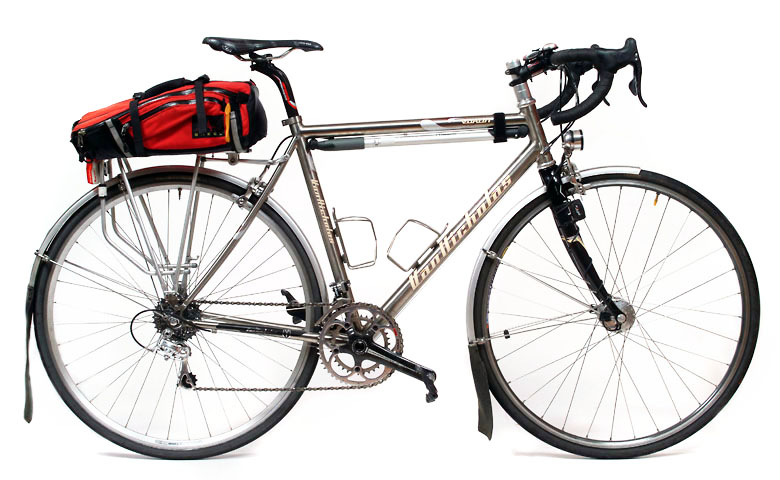
A rando bike designed for comfort and all-weather riding affords plenty of room for larger tires and fenders. Longer chainstays are part of that geometry. Lindsay’s Van Nicholas fits the bill.
I stumbled upon an internet review of the Van Nicolas Yukon bicycle on the Road Cycling UK website. After snapping the drive side chainstay of my Rivendell Rambouillet on a late night decent of the Malahat, I was on the lookout for a new bike for randonneuring.
The Van Nicholas web site describes the Yukon as “an all year round solution that’s ideal for Northern European conditions”. Finally, a bicycle company that acknowledges that we don’t all live in Tuscany! It rains where I live, so I was looking for a road bike that accepts fenders—real fenders, with lots of proper mounting points and plenty of room. The rust-proof nature of a titanium frame had real appeal to me as I’m not a bike polisher by nature.
I ordered the frame via the Van Nicholas website. After tracking its birth in China, its trip to Amsterdam (via Brussels), it arrived in Canada six weeks later with more travel miles than me. The people at Fairfield Bicycles, in Victoria, built the frame with Campy Chorus and FSA components. The Challenge 27 mm tires fit neatly within the SKS fenders, and the wheels can be installed with tires fully inflated thanks to the Tektro “Bigmouth” long reach brakes.
Lighting is provided by a SON 28 dynohub and Edelux LED headlight. The Arkel Tailrider is supported by an aluminum Axiom “Streamliner” rear rack.
The Yukon’s ride is very similar to my old Rambouillet. This is not surprising, since the geometry is very similar. However, the Van Nicholas benefits from a stiffer front end and is a more confident descender. The feel of the titanium frame is more damped than my old ride—a real benefit on our chip seal roads. There are absolutely no fender rubs or rattles, and the bike is a delight to ride. All in all I am very satisfied with my “mail order bride”.
Chris Cullum
“I believe the front loading approach makes a lot of sense for a randonneuring bike.”

There’s nothing fishy about Chris Cullum’s custom Coho; it is a fully-realized randonneuse, inspired by the French constructeur tradition.
I knew before I had ridden my first brevet that I wanted a traditional French-style randonneuring bicycle. The French constructeurs considered the long distance bicycle as an integrated machine, not simply a frame with parts tacked on. Based on this goal, I considered a few different builders and finally decided on Chuck Lathe at Coho Bicycles.
The frame set uses traditional lugged construction with minimalistic Henry James lugs, silver brazed with lightweight standard gauge tubing. There are all the requisite braze-ons for front rack, fenders, rear light, shifters, water bottles, pump and even old school Mafac centrepull brakes. The frame has a simple yet durable single colour powder coat paint job with subtle graphics.
Coho Randonneur bicycles come with a custom front rack and decaleur for mounting a handle bar bag. People have differing opinions, but I believe the front loading approach makes a lot of sense for a randonneuring bike. The front bag incorporates a map case for the route sheet and puts items such as food and jackets close at hand. The traditional French canvas and leather Berthoud GB25, can handle most everything I need for a long brevet. Accordingly, the bike was built with low trail geometry—much more fork offset (6.0cm) than is typical these days.
The frame has a 60cm seat tube, 58.5cm top tube, 45cm chainstays and a low bottom bracket (8cm BB drop). The head tube is 73 degrees and I opted for a slightly slacker seat tube of 72, to allow sufficient set-back of my preferred Brooks B17 saddle, which has shorter rails than most modern saddles.
For long distance comfort without sacrificing speed, I had the Coho specced to accommodate relatively wide 30-32mm tires with fenders. I used 43mm Honjo aluminum fenders that give excellent coverage, are light weight and rattle free. The tires are Grand Bois Cypress 30mm, which have the fast, supple casing of a race tire combined with the comfort of a wide tire. This is a fantastic combination for real world roads (and even an off-road excursions).
I am very much a do-it-yourselfer, so there was no question I would build up the bike myself. I debated what type of shifting system to use. I liked the simplicity of downtube but also appreciated the convenience of both bar-ends and “brifters.” I decided on Campagnolo Ergopower, using a JTEK Shiftmate to allow the use of 10-speed shifters with a Shimano 9-speed drivetrain. I use a modified 13-30T 9-speed cassette with an older Ritchey 46/34T double crankset and a tried and true square taper bottom bracket. This gives me a pretty good range. I don’t have use for very high gears. The compact double works well for my style of riding; I stay in the big ring most of the time, unless there is serious climbing. The Shimano Dura Ace rear and XTR front derailleurs handle this combo well.
As mentioned, the Coho was built with braze-ons for Mafac centre pull brakes. Don’t be fooled into associating centre pull brakes with 10-speeds from the 70’s. Mafac brakes are light, powerful, easy to modulate, provide great clearance and are squeal free when you use Kool Stop salmon pads. The steerer is a traditional 1″ threaded with a Chris King headset. The bar, stem and seatpost are all Nitto. I wanted to wear shoes that I could walk easily in so I use Shimano A520 SPD pedals. Accessories include Ciussi stainless steel bottle cages and Japanese bell.
I built the wheelset using DT double-butted spokes and 32 hole Mavic Open Pro rims. The front wheel incorporates a Schmidt SON 20R generator hub powering an IQ Cyo LED headlight. The 20R was designed for smaller (20″) wheels but newer LED lights do not have the same energy draw as older halogen lights, therefore this hub works well. It is lighter and has less resistance than the SON 28. The front rack has an integrated mount for the headlight and braze-on loops for the wiring. I installed a wired B&M Seculite fender-mounted tail light. A braze-on mounted, battery-powered Planet Bike serves as an auxiliary light.
The overall design is quite traditional, but the integration yields a bike that is actually respectable in weight. Outfitted with fenders, lights, cages and rack (without front bag) the weight is around 25 lbs.
I was a rookie randonneur last season but completed the Super Randonneur series on my new Coho. I was very happy with the ride and performance and I am a total convert to the low trail, front loading approach. In the end, I chose a custom randonneur bicycle not because I have unusual dimensions or because I wanted unique lugs or paint but because I wanted a thoroughly thought out and integrated randonneuring bicycle that could reliably tackle any road in any weather condition.
Ken Bonner
“… S&S couplers were incorporated. This assures the bike can go by air as checked baggage”

Over the years, Ken Bonner has racked up 200,000 kilometres on a titanium Lightspeed “Natchez” and another 100,000 on an aluminum Klein “Performance.” For his new rando bike, he approached local Vancouver Island custom builder Al Bergman to construct a custom ti machine.
My priorities for a new rando bicycle were for a light, tight, responsive, comfortable and durable machine that I could pack up for air travel.
Frame
The top tube was lengthened by ½ cm over the Litespeed, in anticipation of a shorter (110mm) stem. The overall height of the main triangle and bottom bracket were dropped about ¾” [from the Litespeed] (to 26 cm), lowering my centre of gravity. The seat tube length went from 54 to 52 cm. Oversize titanium tubing was used.
To facilitate travel, S&S couplers were incorporated. This assures the bike can go by air as checked baggage. Couplers add weight, but the result is still lighter than the Litespeed. Forks are Alpha CS 25 (carbon fibre).
On the Litespeed, I had extra stuff lashed to the frame for long brevets. Therefore, I wanted braze-ons for water bottles. Even if I don’t use them [Ken prefers a Camelback for hydration], they can be handy for carrying extras, like a spare tire. There are also fender and rack eyelets.
Components
Headset and bottom bracket: Chris King. Bars: PRO PLT with Syntace C3 clip-on aero-bars. Stem: Thompson.
I chose Shimano DurAce STI shifters. I considered the new electronic shifting system, but although racers have used it over considerable time and distances, I was not convinced it would be invincible over the long hauls that we ride in isolated areas.
The Litespeed has a 30-39-53 triple crankset with 11-30 or 11-32 9-speed cassettes. I settled on 34-50 Dura-Ace compact cranks and 10-speed 11-28 cassette. I suspect I’ll be doing more standing on the hills. Pedals: Speedplay X-series titanium.
Brakes are Shimano long-reach calipers that allow the use of tires up to 28mm, though I’m using 25s at the moment—Vittoria Rubino Pro Tech. I enjoy the added comfort over the 23s I’d been using. Wheels: Mavic Ksyrium SL.
I transferred my Fizik Arione seat and shock absorbing seat post I’ve used for about 15 years, set at a medium-hard ride. I find the Arione a little hard for the first couple of kilometres, then body heat seems to warm it up and it becomes very flexible.
Accessories
The custom steel rear rack has 4 bosses for rear lights — assurance for bad weather and battery/light failure. The rack also incorporates an attachment to the rear fender, so the rear part of the fender comes off with the rack, or I can use the rack without the rear part of the fender. The front of the rear fender is permanently attached to the main frame in an effort to cut down on turbulence created by the back wheel.
Although the combination of rack and bag weighs one kilogram empty, I can’t really feel the difference between having the rack attached or not. My pump, extra tire, tubes, lights, jacket, etc. all fit in the Arkel Tailrider.
The small headlight on the clip-ons is a Light & Motion Stella Double-Eh! (LED powered by 4 AA batteries, rated about 2 hours. This of course won’t get one through the night. My main light is a helmet-mounted Light & Motion Seca 700 Ultra with rechargeable ultra Li-on battery. Tail-lights: 2 BLT Fantom XR9—very bright and waterproof after long hours in heavy rain.
With several thousand kilometres on the new bike, I notice comfort over the long haul, responsiveness as a result of the shortened stem, especially when climbing out of the saddle. It feels like I am part of a compact efficient machine, with no wasted energy.
Susan Allen & Doug Latornell
“I wanted a bike that, even if I hadn’t ridden it, someone had and thought it was excellent..”

Susan & Doug put a lot of thought into their newest long-distance machines and it paid off.
Susan, on bike choice:
Our original rando bikes were Marinoni touring bikes. They are great bikes, ride lovely, and we did PBP 2003 on them. However, given the stout tubing, they are heavy and we wanted component updating.
We had two major priorities for these new bikes:
1) The ride had to be excellent including good fit and all day comfort, lightness, good handling and great feel
2) We wanted S&S couplers.
We were looking at higher end sport touring bikes. We considered custom but I was worried. I have had friends get custom bikes from excellent frame builders that just weren’t right (speed wobbles, etc). I wanted a bike that, even if I hadn’t ridden it, someone had and thought it was excellent.
We had had the Marinoni’s cut and coupled with S&S couplers and we wanted the same on our new bikes too. Couplers only fit round tubes and very few modern bikes have round tubes, so this requirement did limit our choice.
I spent a lot of time on the web and there were a few close contenders, but after reading a glowing report on the Gunnar Sport, we decided to take the plunge.
I was so happy when the frames arrived and the ride was, well, simply awesome! Part of it is the very good job that Ed Luciano at Mighty Riders did at fitting us on the bikes.
Doug on component choices:
The component spec for the bikes grew out of 2 decisions:
- We wanted to use the IRD Mosiac carbon fork offered by Gunnar, because it has all the advantages of a carbon fork with enough clearance for a mudguard and a 26 mm tire, and it has eyeleted drop-outs for mounting the mudguard and lights.
- We wanted to use a Campagnolo Centaur gruppo.
The choice of the Mosaic fork broke the choice of a full Centaur gruppo because the brake reach of the Centaur front brake is insufficient. The solution are Shimano BR-R600 units. Campagnolo purists may squirm, but our experience has been that they are a dual-pivot design that brake as well as the Centaur calipers we have on our winter bikes. An added bonus is that changing the blocks is a snap compared to working on Campagnolo brakes. Cane Creek headsets were used.
With the Centaur gruppo broken, we said goodbye to any discount that might arise from buying a complete gruppo instead of individual components, and started evaluating each of the component choices. Ed strongly recommended the FSA Gossamer crankset and bottom bracket because he felt that the outboard bearings, the integrated design of the right crank arm, spider, and hollow, oversized shaft, and the spline mounting of the left crank arm added up to noticeably better power transfer. He was right.
We upgraded the shifters from Centaur to Chorus because the Chorus shifters have a smoother, lighter action.
A pleasant couple of hours spent with the Campagnolo catalog, comparing features, weights, etc. of the rest of the components indicated that Centaur offered the best value for the rest of the drivetrain. Susan ended up with Record front hubs in a 28-hole drilling.
The stems, bars, seatposts and saddles are all fit components and Ed came up with optimal choice for each of us, sometimes after several rounds of trial and swap.
Susan has Velocity Aerohead rims, and they are all still going strong, 4 years later. For my more Clydesdale-like proportions, we chose DT Swiss rims.
My bars are Ritchey BioMax Pros, the most comfortable bars I’ve ever used. Susan has TTT Morphe bars, and she is very particular about them. The combination of narrow width and the curves work well for her small hands and narrow shoulders. Stems are BBB. Saddles are Sella Italia Max Flite Gel Flow with American Classic post.
Accessories:
- Lights: Bausch & Mueller Ixon & Ixon IQ, mounted on nylon rod machined, drilled, counterbored and filed so they screw into fender eyelets on the front fork. I put one light there, and the other on the bar so I can flip it to high beam for descents.
- Our computers are VDO C3 DS wireless units. Wireless is nice on bikes with couplers; it simplifies packing.
Things we would change if buying the bikes today:
- Though Susan and I have been okay, our friends Deirdre and Bob [who own the same bikes] have both had issues with the bottom bracket bearings, so there is probably room for improvement there. I have heard that it is possible to retrofit Phil Woods components in the FSA BB, so I may look into that.
- I have not been happy with the DT Swiss rim on the rear wheel. I have gone through 4 rims in as many years, each failing with cracks around the eyelets (and in some cases serious eyelet pull-outs) within a few thousand kilometers. I built my most recent rear wheel on a Mavic Open Pro rim because I have gotten long life from Mavic rims on other bikes.
These are great rando bikes. We agree that they are faster and more comfortable than any of our previous bikes. And the S&S couplers make them very easy to travel with.
Harold Bridge
“The Mariposa is my favourite bike for going places.”

Harold is the proud owner of a fine Mariposa tourer, built by (now retired) master builder Mike Barry. Eighty-two year-old Harold, though also retired from work, still puts in a good day’s work on his bike (or three), totalling 12,000 kms last year.
In 1998, I took possession of a custom Mariposa. Frame geometry: 72° head, 73° seat X 58 cm, with chain stays long enough to keep a pump between the seat tube and the mudguard. I screwed up by getting centre-to-top & centre-to-centre mixed up. It should have been 59cm. Due to that mistake I spent a long time getting the position comfortable.
I retired at 73, at the end of 2000, and planned London-Edinburgh-London in 2001. But Easter Monday, while pre-riding the following week’s 200, had an accident and spent 26 days in hospital. As for the bike, it cost $80 for Mike Barry to replace the Mariposa’s top and down tubes, but another $150 for the paint job. As Mike has retired now, perhaps the Mariposa is a collectors’ item?
By 2002, I was able, on my Mariposa, to complete my first Super Randonneur since 1994. It was rather a slow one; I think the 600 took me 38 hours. But at 75, I was thankful I could still think in those terms.
I normally use the cheapest Campag gear versions, in this case Mirage. But unlike my old 8 speed mech, I find the 9 to be more fragile and the stop has broken a couple of times. In the end, that was replaced with Veloce. The 9-speed cassette—a civilized 14-28— was sourced from Marinoni. The cranks are 175 mm, with SPD pedals.
The brakes are Shimano dual pivot that fit full mudguards. Wheels: Mavic rims on Campag hubs with 32/36 spoking and Michelin Axial carbon 25C x 700c tyres.
I have 3 bags: I normally use the 1991 PBP Serratus wedge bag from MEC. It has 4 slots cut in the bottom to thread extra stabilization straps underneath.
I also own a Carradice wedge that is good for a weekend ride. I also have a Carradice Long Flap Camper saddlebag, current dating from 1993 and third since 1956. It gets used for utility purposes, supported by the $100 chrome custom bag support, manufactured by Mike Barry.
The Mariposa is my favourite bike for going places. It has taken me across Canada, the length of the British Isles and across France a couple of times.
Lee Ringham
“So far, the Surly has served me very well ….”

Lee Ringham’s Surly keeps on truckin.’
My first randos were ridden on a 1984 Vitus aluminum frame, a full-on racing bike I built up in 1984. It featured tubular tires, a close ratio, 6-speed block on the back and large chain rings up front. While it served the purpose, it was a bit like using a Ferrari for touring. It did the job, and did it very well, but it lacked certain creature comforts—like fender and rack eyelets, a second water bottle cage, a comfortable saddle and easily repairable tires.
So I started looking around for a better-suited machine. I quickly discovered theat buying an off-the-rack randonneuring bike is damn near impossible on Vancouver Island. I tried “sport” bikes, I tried cyclo-cross bikes and I even tried to find touring bikes. Finally, I stumbled across a Surly Long Haul Trucker, which is a touring bike, but I bought one thinking:
- The bike is stable and comfortable, which are traits that are invaluable after 15 or more hours riding, when you kinda go brain dead.
- This bike is $1,250 fully equipped; what a great buy!
- This bike will take racks and fenders, which randonneurs really need.
- It is a great starter bike and if I decide to stop rando riding, I am not out a lot of money.
The stock components were a good mix of serviceable parts. The hubs and derailleurs are Shimano XT. The bottom bracket and cassette are generic Shimano. The brake systems are Tektro and they squeal no matter what I do to adjust them. The problem appears to be too much play between the cantilevers and the braze- ons.
The crankset has been changed from a Shimano XD triple, with 48-36-26 chainrings, to Shimano PX with 44-30 chainrings. The pedals are mid-90’s Shimano Dura-Ace.
I have equipped it with a Nitto M-12 front rack and a Berthoud bag. I started with a rear rack, but it proved difficult to get gear in and out of a bag that is behind you. The Bethoud also has a handy route sheet holder and lots of nifty little pockets so you can overload your bag really easily with stuff that you might just need! I built my own decaleur, as I could not see paying $70 for a small piece of machined aluminum rod.
To run lights, I added a SON 28 dynohub and built a new front wheel to go with it. I added an IQ Fly headlight, and made my own mounting bracket (out of aluminum) that mounts on the rack and holds the bottom of the light. The bracket is like a misshapen letter C. A Busch & Müller Toplight rear light, mounted with yet another DIY aluminum bracket, lets me be seen from behind.
For my comfort, I added a venerable Brooks B-17 saddle and some massive 55 mm Velo Orange aluminum fenders. This bike also serves as my daily commuter, so fenders and a big front flap are necessary to keep me dry and my bike mostly clean.
So far, the Surly has served me very well, but I have come to realize that it is not really well suited to randonneuring, mainly due to excessive wheel flop that is exacerbated by a front load. However, for the price, it remains pretty much unbeatable value and for more loaded riding, it’s great!
Dave Macmurchie
“… it’s my trusty velo, and I’m very attached to it.”

Dave has lavished his trusty tourer with shiny new parts and it has stood by him through several seasons of brevets.
I bought my bike from Cap’s Cycle in New Westminster, around 1983. It’s a Carlton, from Worksop (not sure of the model) but the frame was all double-butted Reynolds 531. The components were mediocre, but they served for quite a while.
The upgrade process started when I bought new tires, in late 2006, and discovered that they wouldn’t stay on my rims. It turned out that in the intervening 20 years, hooked rims had appeared on the scene, and contemporary tires simply blew off my old smooth ones.
I bought a pair of used wheels, Mavic MA2s on Record hubs, from Gerry at Straight Up in Victoria, and in so doing came across a rack card for the 2007 Victoria Populaire. Of course, the new wheels were 700c and the old ones had been 27 inch, so the brakes no longer quite fit. A Dremel tool did the job, but I shortly after took the plunge on a set of Tektro long-reach brakes, which have been fine.
I followed up on the VicPop, and discovered randonneuring, which was something of an epiphany. I finished the Tour of the Cowichan Valley in better shape than the bike’s original saddle, so I decided to take the plunge on a Brooks B17. We’re now fairly well acquainted.
Next to go was the noisy Sugino Maxi crankset and bottom bracket. A discussion on the BC Randoneurs list on the relative merits of triple versus compact double led me to a virtually unused Record triple, from another club member.
I inevitably discovered that Vancouver Island brevets are not entirely flat. Additionally, I am not entirely slender. I tried to resolve this mismatch by changing from the bike’s original 13-30 six-cog freewheel for a Shimano MegaRange freewheel, with its lovely 34-tooth bail-out gear. This was a big improvement for getting me up hills, but the gap from 24 to 34 was pretty startling, so I was glad to find that IRD made a seven-cog freewheel that still fit my old narrow dropouts and inserted a 28 into that gap. It was expensive, but definitely worth it.
These changes required a larger-capacity rear derailleur, so the original was replaced with a Shimano Alerio. Around the same time, I replaced the original downtube shifters with bar-ends. The Suntour front derailleur was replaced with a Campagnolo Mirage.
At this point I think the only original parts are the frame, stem, bars and brake levers, and even the frame was touched up a few years ago by Sam Whittingham, with some new braze-ons and paint. Still, it’s my trusty velo, and I’m very attached to it.
My “cockpit” sports a common Garmin GPS, but the decidedly un-rando bar bag contains a battery pack that I have contrived to enable it to run longer than its usual 8.5 hours. The pack consists of 8 rechargeable AA-cells in series, delivering current through a 5v regulator IC to USB port, so it will power or charge anything that accepts USB power—GPS, Blackberry, cell phone, etc. I bought the parts and adapted the circuit plans from Electroids, but I’ll gladly share what I’ve learned with anyone who’s interested.
The MagicShine light on the left side is a Chinese knock-off of a Lupine Tesla, at about 1/5th the price. So far, it’s been terrific. I haven’t tested the run time personally yet, but the claim is 3 hrs on high and much longer on low, using the supplied rechargeable pack. As above, I have contrived my own battery pack that lets me replace rechargeables with spares, so I think there is enough run time to see me through the night. While this is not the “gold standard” in lighting, for $90 all in, it’s worth a look.

 Latest Tweets